
Beyond Backups: Business Continuity That Works.
3–4 minutes read
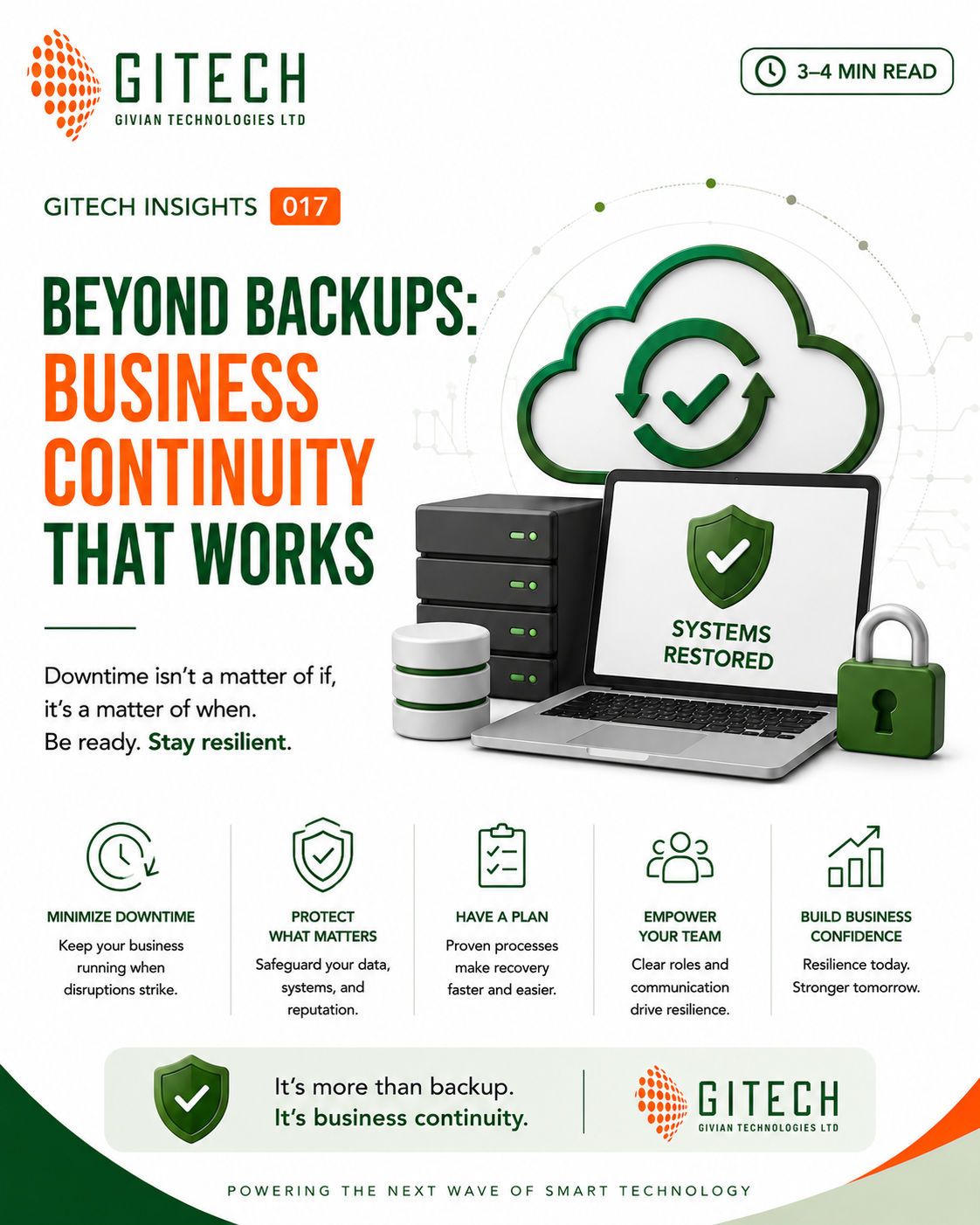
Downtime isn't a matter of if. It's a matter of when.
A power failure, equipment failure, cyberattack, data loss or other disruption can interrupt operations without warning.
Having backups is important. But a backup sitting safely somewhere does not automatically mean your business can recover quickly.
Business continuity goes beyond backup.
It is about preparing your people, systems, infrastructure and recovery processes so that your organization can continue operating when disruption occurs.
Backup is only one part of the picture
Many organizations think about continuity as:
Something goes wrong → restore the backup → continue working.
In reality, recovery can involve much more.
You may need:
- Reliable backup power
- Working network and IT infrastructure
- Protected business data
- Defined recovery procedures
- Clear responsibilities
- Tested recovery processes
- Communication between the people responsible for restoring operations
A business continuity approach considers the entire operating environment rather than one component.
What does business continuity protect?
Business continuity is ultimately about protecting what keeps the organization functioning.
Your operations
Critical systems and equipment need to remain available or be restored quickly when disruption occurs.
Your data
Business information must be protected and recoverable when it is needed.
Your people
Employees need to know what to do when normal operations are interrupted.
Your customers
The longer an organization is unable to deliver its services, the greater the potential impact on customers and reputation.
Your business confidence
A documented and tested continuity approach gives management greater confidence that the organization can respond when something goes wrong.
Five principles of effective business continuity
- 1Minimize downtimeThe first objective is to reduce how long your business is affected. Reliable power infrastructure, resilient IT systems and appropriate recovery procedures can help keep critical operations running when disruptions occur.
- 2Protect what mattersNot every system or piece of data has the same business importance. Identify the systems, information and equipment that are critical to your operations and make sure they receive the appropriate protection.
- 3Have a planRecovery should not begin with people asking: “What do we do now?” A practical continuity plan should establish what needs to be recovered, who is responsible and what steps need to be followed. Most importantly, the recovery process should be tested rather than simply documented.
- 4Empower your teamTechnology alone cannot create business continuity. People need clear responsibilities and communication during a disruption. Everyone involved should understand their role and know how to respond when normal operations are interrupted.
- 5Build business confidenceResilience isn't just about surviving an incident. It is about creating an organization that is better prepared to respond, recover and continue operating. Resilience today creates stronger business confidence tomorrow.
Where power continuity fits
For many organizations, business continuity begins with something very basic: keeping critical equipment powered.
A server, network, security system, workstation or other business-critical equipment cannot continue operating when its power source is unavailable.
Gitech's Power Continuity solutions cover UPS systems, battery energy storage, solar and hybrid systems, critical power infrastructure, and service and maintenance.
This means power continuity can form an important part of a broader business continuity strategy.
What a practical continuity approach looks like
A useful starting point is to work through five questions:
- 1What can stop our business?Identify the power, technology, environmental and operational disruptions that could affect you.
- 2What must keep running?Identify your critical systems, equipment and processes.
- 3How long can we operate without them?Define acceptable downtime and recovery priorities.
- 4How will we recover?Establish the technology, infrastructure, people and procedures required for recovery.
- 5Have we tested the plan?A plan that has never been tested may not work when you actually need it.
How Gitech can help
Gitech approaches business continuity from an engineering and technology perspective.
We can assess your environment, understand your operational requirements and help identify appropriate power continuity and IT infrastructure solutions.
Our Power Continuity services include:
- UPS Systems
- Battery Energy Storage
- Solar & Hybrid Systems
- Critical Power Infrastructure
- Service & Maintenance
The objective is simple:
Don't just back up. Be ready to recover.